


by Gabe 5/2/2017
Wood floor finishing is a complicated subject with many aspects to consider. Solvent or waterborne finish? Stain or natural? How many coats? It's a lot to take in all at once. The aim of this article is to serve as a reference and hopefully to help make sense of all the ins and outs of deciding what kind of wood floor finish is right for your unique needs.
Penetrating oil finish
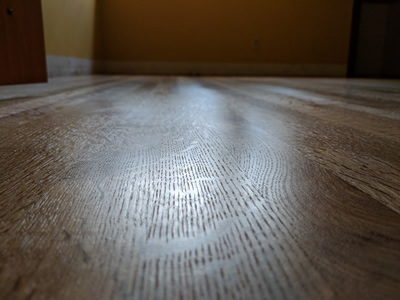
European style penetrating finishes, or "hand rubbed oils", are finishes that get buffed into the wood rather than applied as a coating and allowed to dry, as is the case with a typical film building finish. These finishes are unique in that they penetrate into the wood, using the strength of the wood for their durability rather than relying on a thick plastic-like coating. This results in a final product with no film build and a relatively low matte-like sheen. From a utility standpoint this makes it harder to see common damage like scratches or grooves in the finish, from pet claws for instance.
Another benefit of these finishes is the ability to successfully perform a "spot repair". When a floor sustains some kind of damage that goes through the finish, it's nearly impossible to spot sand it out and blend it in with film building finishes, the coating always shows a "halo", or obvious line where the finish was blended. With penetrating finishes this is not an issue since there is no layer of finish getting sanded to blend in the repair, though a spot repair could appear lighter on an older floor whose color has aged a bit. This means that the spot repair will be fairly apparent until the freshly finished area "catches up" with the surrounding flooring, which could take months or longer. Despite that minor drawback, not having to refinish the whole floor could potentially be worth the temporarily unsightly area.
Penetrating oil finishes will require more maintenance than film building finishes (depending on usage). It's not quite as involved as an all out maintenance coat with a film building finish, but it may need to be done more often. Additionally, many penetrating finishes are 1 or 2 coats, meaning once the finishing stage of the process is reached, the project is basically over instead of the normal 2-3 day process that requires the home to be vacated. And with 0% VOC, there's no need to be out of the house even during the application. A cure time of only 6 days is required prior to placing rugs and/or damp mopping with the approved cleaner.
Single component waterborne finish
These finishes are moderately priced and have mid-range durability. Normally three coats are applied- two finish coats over a sealer coat. They are shaken and applied straight out of the container- no harderner or catalyst required. Most of these products tend to turn more yellow or amber as they age, especially with exposure to light, although any finish can allow the wood to become "bleached out" from exposure to UV light coming from a nearby window. Some higher quality finishes do contain UV inhibitors which help protect against, but don't totally prevent UV damage. Many finish manufacturers are now offering non-yellowing single component waterborne polyurethanes that are still relatively affordable compared to the 2 component upgrade.
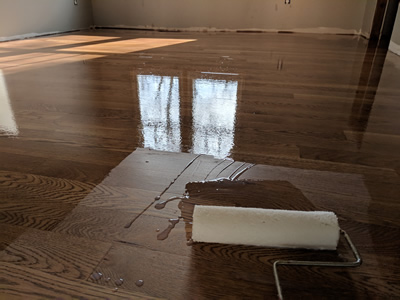
Waterborne polyurethanes offer some advantages over solvent based finishes, including less harsh fumes or potentially harmful chemicals, as well as quicker drying and curing times. The fumes are comparable to latex paint and the finish only needs about four hours of dry time. Usually two coats can be applied in one day requiring a block of eight to ten hours before it can be walked on in socks. They are somewhat easy to apply but go on thinner than solvent finishes, resulting in a coating with less film build. Most are fully cured after one week.
Two component waterborne finish or conversion varnish
The finishes at this price level are superior in performance to the standard finishes but they do have some disadvantages. They have two parts which are mixed and then need to be applied within a limited timeframe, inevitably leading to wasted product. The two component waterborne is a fantastic and very durable finish with all of the advantages of waterborne listed above, except it can be somewhat more difficult to apply and certainly costs more. The conversion varnish is arguably the best finish available, but the fumes are extremely harsh.
TWO COMPONENT WATERBORNE
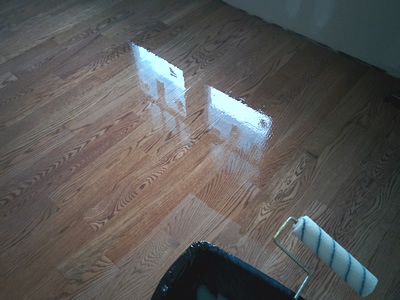
The better quality two component waterborne polyurethanes are similar to epoxy in that the leftover finish from coating will harden up in the jug. It must be applied within four hours of being activated (mixed), whereas some two component waterborne finishes can be applied up to 24 hours later or be recatalyzed. Normally three coats are applied- two finish coats over a sealer coat, although some higher quality products can be applied thickly with a roller to only require two coats, which adds an hour or two of drying time. The fumes are worse than regular waterborne but still benign compared to any solvent finish. A great advantage of this finish is that it does not significantly turn amber or yellow over time as solvent finishes and some waterbornes do. This finish cures faster too- fully cured in only 3 days.
CONVERSION VARNISH
Conversion varnish is an acid curing two component solvent finish that is arguably the most durable finish we use, but also the trickiest to apply. People, pets, even food should be removed from the area due to the nasty fumes. The normal system only requires two coats because it goes on very thick with an optional third coat for the high build system. We like to set up large fans to evacuate the fumes if weather permits, but the effects can linger for a day or two after the final coat, depending on air movement and exchange with the outside air. This type of finish dries almost as fast as a waterborne finish but takes longer to fully cure like other solvent based finishes. Some take only 7 days for a full cure, some can take up to 90 days.
Application of stain
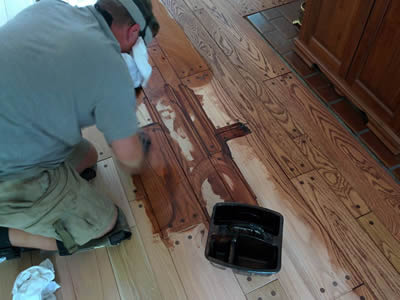
After sanding, the bare wood can either be coated with sealer for the natural wood color or stained darker. The best approach is to do samples to be sure the resulting color and finish are satisfactory. The wood must be sanded to a finer surface in preparation for staining to avoid unsightly swirls. The stain is wiped back instead of spread out like sealer and finish, only offering minimal protection for the wood and little build for the finish. We only use oil-based stains that are made for wood floors, which have somewhat harsh solvent fumes. The stained surface can be walked on in socks after about four hours of drying time. Any of the finish systems we use can be applied over the stain. Overnight drying is required to coat over the stain in normal conditions, the white and black colors take even longer to dry.
Water pop
Water popping is a technique used to open the wood grain by dampening the wood surface with water and then allowing it to fully dry. This process causes the surface of the wood to swell slightly, which opens the pores of the wood and allows the stain to soak in deeper for a darker and richer color. The water popped wood surface is very fragile until it gets stained so absolutely no one is allowed to walk on the floor during this time.
Additional coat
This upgrade is to apply another coat of finish, resulting in a thicker coating. The coating will not actually be harder but there will be more finish to wear through. Also the coating appears a little thicker and the grain is slightly less pronounced on open grained woods, making the finish look more like a traditional oil-based polyurethane. The additional coat is not needed for a beautiful and long lasting finish but it may prolong the point in the future when a maintenance coat will be needed. There is some debate about how much benefit if any there is from the additional coat. After a certain amount of coats are applied the floor will eventually develop a problem called overfinishing, where the coating is too thick in places to have a nice even appearance and wearability. It is arguably better in the long term to save that additional coat as a maintenance coat for the future when it is needed, and at the same time prolonging the issue of overfinishing.
Hopefully you are much more well informed about the complexity that is inherent in deciding what finish system is appropriate for your situation. We are here to help you translate that information into great looking durability for the long term.